What wine to drink with Shepard’s Pie tonight?

First of all, my wife makes a mean Shepard’s Pie, and I am providing the recipe for you here from her great food blog, DAZ in the Kitchen.  She publishes a lot of great recipes for food and article on food lifestyle.  Her meals are a joy to me because (1) they taste good and nourish me in their own right, and (2) provide me an excuse to pick out a nice bottle of wine to go with dinner!  My friends who have had her Shepard’s Pie love it and fight over ‘take home’ if there is any leftover.

While there are a number of secondary red grapes (see my post on Malbec as an example and what constitutes a ‘secondary’ grape) that may match well with Shepard’s Pie, I only focused on considering a Shiraz, Cabernet Sauvignon, or Pinot Noir.  Merlot could have also been a good choice, but I never really think of Merlot, plus I like to have a glass of the wine we are having with dinner beforehand (I am drinking it as I write this!), and would rarely consider drinking a glass of Merlot on its own, when there are so many other great wines from better grapes (at least in my opinion) to choose from.

The main ingredient in Shepard’s Pie is lamb mince and that means a decent Pinot Noir could match up well.  However, a good Pinot Noir is so refined and elegant, and Shepard’s Pie has a lot of other ingredients in it such as bay leaves, Worcestershire sauce, tomato paste, and a lot more.  A good Pinot Noir deserves to be matched with lamb shanks or some other lamb dish other than as mince.

The same is true of Shiraz.  It deserves to be matched with a large slab of beef, well seasoned of course, but with the structure and thickness of the beef intact.  This left a Cabernet Sauvignon as a splendid choice.  But then there was the question of ‘which’ Cabernet Sauvignon?

Shepard’s Pie is a very pedestrian dish.  Don’t get me wrong, I absolutely love it and drinking wine with it, but it has a lot of different good, yet cheap flavors involved in its creation.  (In fact, I always like to have some leftovers because once Shepard’s Pie sits for 24 hours, the flavors co-mingle so beautifully and I love it even more the next day!)  That means an aged or too refined a Cabernet Sauvignon would overwhelm (or possibly even embarrass) the Shepard’s Pie.  Therefore, I need to find a decent, yet pedestrian Cabernet Sauvignon also to compliment the Pie.

My choice was the 2002 Stonefields Vineyards from Wrattonbully, a region in South Australia, south of Adelaide and just west of the Victorian border.  Wrattonbully is known for its great Cabernet Sauvignons.  This is a $25 bottle of wine, nicely aged with a bit of complexity, but most importantly it is evenly matched with the Shepard’s Pie and will not overwhelm it.

While I have had better (and much more expensive!) Cabernet Sauvignon wines, this one is very good for the money and also matchings very well with lamb mince infused with the variety of flavor the rest of the Shepard’s Pie provides.

I must admit though, now as I write this that while I would not match up a 100% Merlot with Shepard’s Pie, the thought of a Cabernet Sauvignon / Merlot blend could be a very good match, and I think I will marry the Shepard’s Pie with a Cabernet Sauvignon / Merlot blend the next time to see how it goes.

I am looking forward to dinner and wine once again this evening and will let you know how the combination works in the near future.

A “wino’s” photo album

Our leaving Qatar and returning to Australia in the middle of 2009 was a bit of a shock.  I was feeling bitter about what had happened, how unfair it was and how it cost us a fortune because of petty politics, both within the bank and within the royal family of Qatar.  We were jobless and homeless and had only enough money to pay the previous year’s taxes and live for about 6 weeks before we would have gone broke.  Prospects were pretty grim, especially given the GFC was rolling downhill quickly at the time!

Fortunately within two weeks, Deanna had her old job back, and my prospects were looking good, with three job offers firming nicely.  Once we found a place to live and both secured jobs, I was starting to put the terrible experience behind us, and really wanted to treat myself to something special, and for me, that would be a most special bottle of wine, which seemed to be a good cause for celebration, especially after coming from a controlling, alcohol-restricted country!

My wine was all stored in a public cellar as I had moved it out of the cellar I built in our house (which we were leasing out at the time).  Therefore, once we purchased a car, I headed over to my cellar and pulled out my oldest and dearest bottle of a 1954 Lindemans Vintage Port.  It was a truly heavenly drink and I had it over several months, relishing every drop.  It came in a beautiful bottle (the label actually) and was a real treasure.  I wish I had a picture to show you, but I threw the bottle out when I was finished as we were living in a small apartment and space was at a premium.  This was a mistake I have regretted ever since.

As much as I missed that bottle, it taught me from then on to save my ‘precious’ wine bottles and to display them.  They provide great memories and for each great bottle of wine, I can remember the time and the people I shared it with and with reasonable clarity (especially difficult since most of these moments involved a lot of wine!).  I call this ‘my photo album for winos’.

In fact, I almost get as much joy out of my empties and my memories as I do walking through my cellar and selecting new bottles to drink.  With the bottles in the cellar comes a great responsibility to (1) drink them at the right time (always a challenge if one takes this seriously), and (2) who to drink this particular bottle with?  I sometimes find ‘friend matching to wine’ even harder than food matching!  Whereas with the empties, I just have fond memories of times gone by and the great friendships we have shared.

Yes, this does take some’ real estate’ to store so many bottles, but as you can see, we have used the tops of cabinets and the tops of bookcase for ‘display’ and for very special events such as Deanna’s 40th birthday party, we have turned the display into ‘art work’.

Wow – what an evening that was all around and probably the very best wine tasting evening I have ever experienced (see line-up in picture above)!  9 courses of food perfectly prepared and matched to the wines I selected.  Most of the wines came from Treasury Wine Estates and we had the perfect party served up at Lindemans, organized by Michelle Tracey, with Damien Harrison, who was our personal sommelier for the evening and contributed from his own collection a bottle of 1957 Lindemans Vintage Port (it was as close as anyone could find to the 1954 Vintage – thank you so much Damien!) and the food prepared by Craig Parkinson, Lindemans Head chef, with Pip Mason also serving us that evening.  But Deanna’s 40th and the wines deserve their own blog entry which will follow soon.  This one is really about why to save your empties and how to turn them into memories.

Look at the character of this old bottle of the 1957 Lindemans Vintage Port from Damien!  Water damage to the label, but the wine was exquisite.

These empty bottles really mean a lot to me and I greatly enjoy them over and over again.  Most are displayed at our place in the Hunter Valley.  I only keep one bottle of each (a separate bottle though for each vintage), except for the two best wines in the world – Chateau D’Yquem and Penfolds Grange.  We drink so little of each that we do keep each and every empty we have created!

It takes a bit of room, but after tossing the 1954 Lindemans Vintage Port bottle, I learned a lesson.  That was a bit like tossing a 1951 Willie Mays rookie baseball card!  I greatly regret it and make sure to keep all the precious great bottles I have drunk since.  And if anyone can find me a bottle of the 1954 Lindemans Vintage Port, it will be greatly appreciated – filled or empty!

Wine Snob versus Wine Enthusiast – which one are you?

I must admit that I have a true avocation for wine.  I enjoy wine on its own, with food, and to share with friends.  I also enjoy reading about wine and learning more about how it’s made, where it is best made, how to buy and store it, and how to drink it.

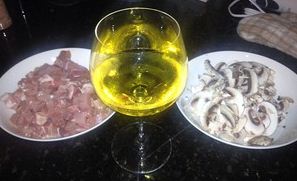
Over time, I have developed a deeper appreciation for the exquisite and multi-dimensional nature of wine and it has become an important part of my life, but no more important than my faith, my job, my friends, my passion for reading on a wide variety of topics, and a general zest for life overall.  I have been able to achieve a deeper experience and understanding of the wines I drink, and that has enhanced some of my other experiences.  For example, we are having a chicken and mushroom risotto for dinner tonight.  My wife makes a really good risotto (you can view the chopped-up chicken and mushrooms below)!

With the chicken, Parmesan cheese and mushrooms, I knew I wanted a rich, aged chardonnay to go with it.  I selected my last bottle of the 2003 Saddler’s Creek Reserve Chardonnay. (Look at the beautiful golden color of a perfectly aged white wine!)  I did so because I have had a few bottles previously and felt it would pair beautifully with a chicken and mushroom risotto, and I also knew the bottle should be drunk in the next few years and I did not want to wait too long or it might go off.  Fortunately the wine was perfect and I am drinking some as I write this posting.  We paid $10 per bottle for the wine as Saddler’s was trying to clear older inventory and we bought the last 8 bottles they had.  But it drinks like a $130 bottle of Penfolds Yattarna or a decent Montrachet.  This turned out to be one of the best buys of my life!

As you can tell, I put a bit of thought into buying the wine in the first place and also when to drink it and what food to drink it with. Some people would claim “I take my wine too seriously, so I must be a wine snob”, but I hardly think that is the case.  To me it is a natural passion or avocation as I mentioned, much like others have a passion for working out or art or literature.  Because I have developed a bit of knowledge over the years, it has become much easier to select a good (and good valued) wine to go with an everyday dinner.  And I put more thought into the wines that match up with dinners when we host our “Single’s and Strays” dinner parties, have friends over, or a special birthday or anniversary.  (BTW, all birthdays and anniversaries are special!)  But then, most of those events become special occasions and lifetime memories.  Does that make me a wine snob?  I don’t think so.

I discussed this with some other wine aficionados and we felt that a wine snob had the following characteristics:

Wine Snob

  • They bragged about the excellent wines they had, but never found the opportunity to share the wine with friends or to give a bottle to a friend
  • They want to have you admit to them having a superior knowledge of wine over you – they are as uninterested in sharing their knowledge as they are their wines – they just want to ‘show off’.
  • They talk a great deal about how much they have paid for expensive wines, and seem to only drink expensive wines

Whereas a wine enthusiast, we felt, had the following characteristics:

Wine Enthusiast

  • They are happy to share wine, either by contributing a bottle, or by asking all who share to chip in for a special bottle of wine, or by setting some rules to have each person bring a bottle according to the rules established
  • They listen to others and want to learn and also share their knowledge and are excited to help others develop an appreciation of wine and mature as a wine drinker and possibly collector
  • They get as much and even greater pleasure out of finding a ‘cheap’ but great wine and would rather drink that than an expensive bottle of wine

We have two friends who are studying to become international Masters of Wine (MW).  An international MW costs about $200,000 to buy, taste and compare wines to develop an internationally acclaimed palate and ability to compare and describe wines to others.  (There are only about 475 MWs globally!)  They are also professional wine judges (in addition to their full-time jobs), but in no way are they wine snobs.  They get great excitement over finding a Canberra (ACT, Australia)  Sangiovese for $20 per bottle and a Marsanne for $15 which they have introduced us to.  A wine snob would not even try a wine from Canberra, yet alone a wine under $20.  We have had a 9-hour lunch at their house (he is French, she is Australian – what can I say?) and we bring over wines we really want to share with them and they pick out wines they really want to share and introduce to us.  These wine may be in the $10 – $20 per bottle range or they may be $40 – $60 per bottle, but it does not matter – what matters is sharing our wine, our knowledge and our friendship with each other.

I therefore, prefer to call myself a ‘wine enthusiast’, not a ‘wine snob’.  How about you?

Wyndham Estate Wine and Chocolate Masterclass

Yesterday, Deanna and I ventured out to partake in one of the many events during the June Hunter Valley Wine and Food Festival.  We visited Wyndham Estate winery just past Branxton, NSW.  As I mentioned in my blog, ‘Wine Tasting Technology Perspective’, I met a ‘friend’ on FaceBook who shared a common interest in wine plus a particular interest in the Tyrrell’s Vat 1 Semillon as he was a rep for Tyrrell’s at the time.  He now works at Wyndham Estate and posted about their Wine & Chocolate matching Masterclass, so we decided to attend.  Another good example of business being conducted via Web 2.0!

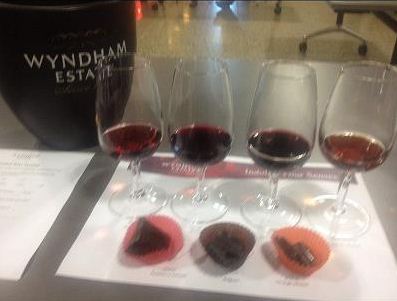
The class had 4 wines (all by Wyndham Estate) which were a Bin 333 Pinot Noir, a Shiraz / Grenache blend (the Grenache really came out, especially with the Raspberry-infused chocolate), a Bin 555 Sparkling Shiraz, and a Rutherglen Muscat.  The chocolates where a Raspberry-infused dark chocolate, a Belgian chocolate, and an Orange-infused chocolate.  Not every combination worked well as you might be able to imagine, but some were really a treat!

The Pinot was fine with the Raspberry-infused chocolate and the Grenache from the Shiraz / Grenache blend really picked up the flavors from the Raspberry-infused chocolate even more.  I personally did not like the Sparkling Shiraz with any of the ‘infused’ chocolates as there was just too much chaos going on in my mouth, but several others in the class liked it.  The Muscat with the Orange-infused chocolate worked extremely well together also.

Both Deanna and I were really interested in what may go well with a Chile-infused chocolate and Cameron Davies, our instructor for the day, had the answer – a big, robust Shiraz!  Wyndham Estate has a great Shiraz, called Black Cluster which is made from 40 year old vines.  We had the 2007 (current vintage) and it was a great wine and good value at $60 per bottle.  And the spice and pepper of the Black Cluster really brought out the chili in the chocolate and the chili really brought out the spice in the Shiraz – it was a wonderful and full-on experience.  Deanna blurted out that “it was like having an explosion in my mouth”!  For me, I will remain a bit more refrained and repeat – ‘it was a wonderful and full-on experience’!

A lot of people have learned a bit (and some a lot) about matching food and wine, and it does, in many cases, truly enhance the dining experience in my opinion.  I also like matching wine and cheese and while any good wine will go with any good cheese, there are combinations that really work much better than others.  The same is true for wine and chocolate.

When we have a 3 – 4 course dinner party, we often start with a Sparkling Shiraz on arrival for drinks until we sit down and get into the first course and the first matching wine.  However, I learned yesterday that a Sparkling Shiraz can go well with chocolate and think it would do very nicely as an alternative to a more traditional desert wine to match up with heavy (or mud) chocolate cake or chocolate truffles to finish a meal.  That is one of the lessons I learned yesterday.  Thanks Cameron for the Masterclass!

Why I don’t write for GT (Gourmet Traveller) Wine magazine

Well, simply because they have not asked me!  I would love to, and I expect so would the other 1,000 or so people who blog about wine.  Of course, I do plan on continuing to improve my wine blogging over the next year and hopefully get some amount of following and notoriety, possibly even some acclaim – who knows?  I have been writing a lot (on a variety of topics, not just wine) more recently, and been doing a lot of editing and guest blogging, so hopefully my writing will continue to improve.

The best way to get into GT Wine magazine is to enter and win their annual Wine Writing competition, of which the next round of submissions is in January, 2013 for the 2013 award.  In the meantime, I am planning on writing on the following topics over the next few months:

  • Why I keep empty wine bottles
  • Mistake of buying too much of a single wine
  • Terroir and its influence on various grapes
  • The difference between a wine snob and a wine enthusiast
  • The wine region Alsace
  • Review of matching wine with food and food with wine for special events
  • Specific wine and wine region reviews
  • Different varieties of corkscrews
  • Use of aerators
  • When and how to decant wines
  • Storing wines
  • Best wine magazines, wine blogs and wine writers to read
  • Wine applications
  • Use of iPad as a wine list for restaurants
  • Why James Halliday pisses me off when he writes about the ’27 Le Tache

and a variety of other topics.  I also plan on including more pictures and links to other resources.  I would be adding a number of pictures now, but we are packing to move apartments and most everything is packed for the move.

Hopefully, you will continue to follow and enjoy my wine blog.  Also, if you have any topics you would like to recommend that I write on, please let me know.  While I am not an expert on wine, I have a growing knowledge base, a lot of friends in the industry and love to share ideas and experiences with others who have a similar interest.